Skip to content
Department Engineering

Electronics and Computer Engineering

My Studies

Practical Projects During Your Studies – Experience Technology, Bring Ideas to Life

In the Bachelor’s degree programme in Electronics and Computer Engineering, theory immediately becomes practice. Every course combines knowledge with hands-on application, using state-of-the-art facilities and real projects. With each semester, the proportion of project work increases – from the first concept to a fully functional prototype.

From Idea to Prototype

Electronics and Computer Engineering students develop projects that make technology come alive:

  • CrazyCar – In the third semester, students in the Embedded Systems course design an autonomous vehicle in which sensors, control systems, and software merge into a self-driving system.
  • Electronic Circuits – In the fourth semester, students design their own circuits and PCBs, which are later manufactured.
  • Prototyping & Device Assembling – In the fifth semester, students handle assembly, integration, and commissioning, creating complete devices from concept to working prototype.
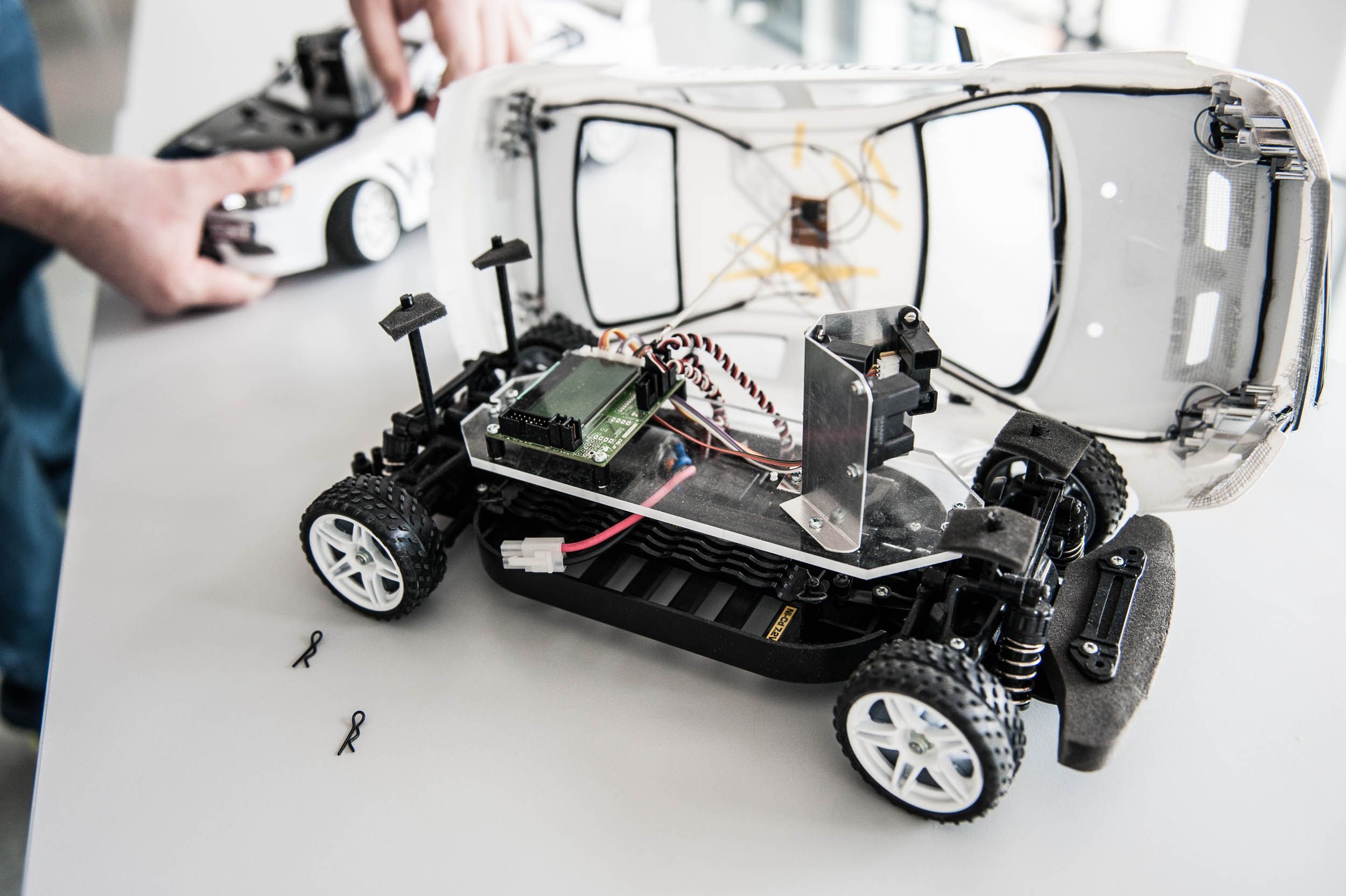
Photo: FH JOANNEUM

The Crazy Car autonomous vehicles project

Teamwork as in Real Life

In the fifth-semester Electronics and Computer Engineering team project, students tackle realistic tasks. Project management, team building, and technical writing are fully integrated. The goal: apply technical knowledge, develop communication skills, and present results professionally.


Why Practical Projects Make the Difference

Practical projects bridge the gap between study and professional life. In industry, theory alone is not enough – the ability to solve complex tasks collaboratively and deliver projects successfully is crucial. Students who gain this experience during their studies start their careers with a clear advantage:

  • Technical expertise through real-world applications
  • Soft skills such as teamwork and communication
  • Industry-oriented experience for career readiness

Current student projects

Gaming Meets Technology – The Motion Platform

Bernhard Stradner, a semi-professional e-sports player, took gaming to a new level:
His project connects a vehicle model directly to a video game. The model was 3D-printed and controlled via a PLC with a PID controller. A gyroscope provides feedback, while two servomotors deliver dynamic action.
Result: Gaming and technology merge – a prime example of practice-oriented innovation in the Electronics and Computer Engineering degree programme.

BalTray – The Smart Serving Tray

Michael Lienbacher wanted to prevent spills and developed BalTray, a self-balancing serving tray. Core feature: a motion platform that compensates tilts of up to 20°. Two motion processing units detect every movement, while three servomotors react instantly. Mechanics were realised through 3D printing, electronics on a custom PCB.
Result: Up to 500 g remain safely on the tray – everyday technology realised in the Electronics and Computer Engineering degree programme.


Rubik’s Cube Solver – Speed Meets Precision

Jakob Soukup and Simon Waldhuber aimed to solve the Rubik’s Cube faster than any human. Their automatic solver completes it in just 20 moves – reliably every time.
Technologies: Rapid prototyping, 3D printing, custom actuator control software.
Result: High-tech meets precision – an impressive example of innovative technology in action.


LED Cube – 4,096 LEDs for 3D Worlds

A cube that lights up, animates, and even displays 3D mathematical graphs: the team developed an LED cube with 4,096 RGB LEDs, controlled by an ESP32 microcontroller.
Challenge: Smooth animations without flickering – solved through clever hardware-software integration and custom PCB design.
Result: Spectacular 3D effects and modular design for rapid repairs – technology that amazes.

This site is registered on wpml.org as a development site. Switch to a production site key to remove this banner.